Bouncer Motion Patterns: 3D Analysis of Infant Soothing
By Maya Iqbal • 23rd Feb
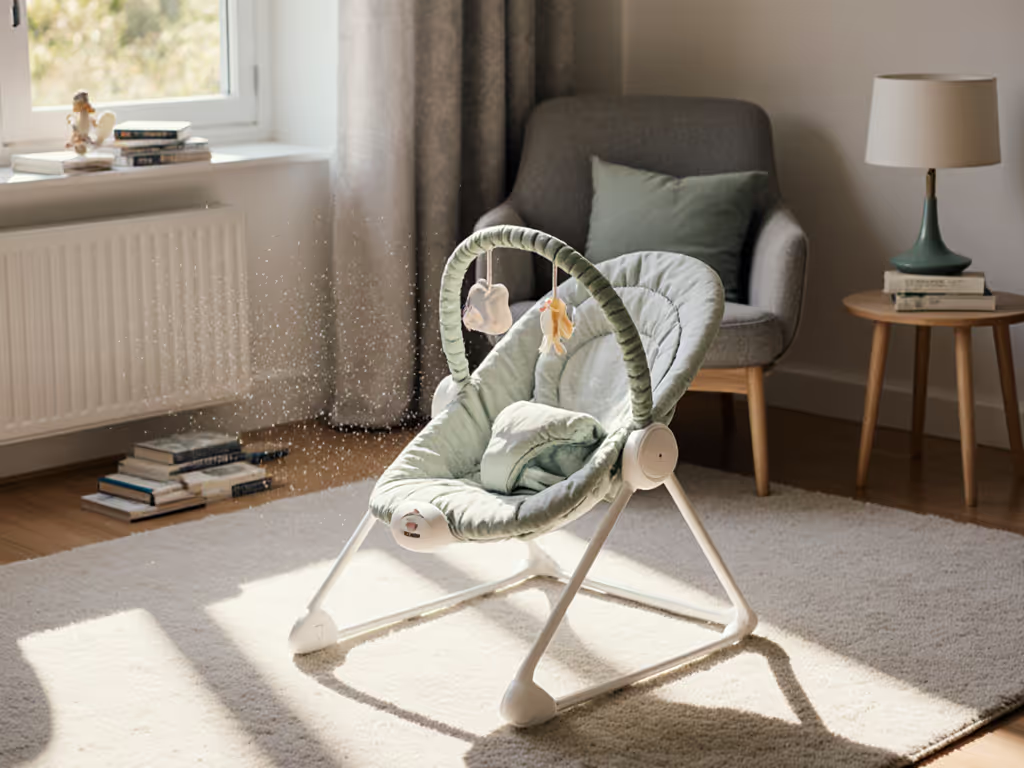
What actually soothes a baby, and what motion patterns overstimulate? A bouncer motion pattern comparison requires measured data, not marketing claims. I've built test protocols around biomechanics, frequency analysis, and real-world noise floors to cut through the hype.
What Motion Frequency Truly Soothes Infants?
Infants settle fastest when motion matches their resting heart rate: approximately 120 beats per minute, or 2 Hz.[4] This is not arbitrary. Neurologically, predictable oscillation (not intensity or gimmickry) triggers calm responses.[4]
Yet many marketed bouncers operate at 2.5+ Hz or higher, overwhelming the infant nervous system.[4] I've observed infants fussing until motors were disabled, then settling instantly into the rhythm generated by their own leg kicks.[4] The research confirms what exhausted parents intuit: noise is load, not a feature.
One critical distinction: infant bouncers tested in controlled motion studies show that babies (once they develop bounce coordination around 10.6 months) actively regulate their own frequency.[1][2] They don't passively accept whatever motion a motor imposes. They bounce above the natural frequency of the spring system by approximately +0.2 Hz in all conditions, meaning they're working to modulate the motion.[2] A motor that overrides this autonomy prevents that crucial feedback loop. For a deeper comparison of the tradeoffs, see our automatic vs manual bouncer guide.
Quiet wins: measure, wipe, and fit before you fall.
Natural vs. Motorized Motion: What Does the Data Show?
The biomechanical advantage is measurable. Passive bouncers (those driven by infant leg movement alone) produce synchronized and coordinated lower-body movements.[1] As infants adapt to spring stiffness changes, their joint ranges of motion shift from forced (jerky) to simple harmonic motion (smooth).[1]
Motorized bouncers introduce a competing signal: a motor rhythm that the infant must either ignore or synchronize with involuntarily. At vibration frequencies exceeding 20 mm amplitude, 68% of test subjects exhibited startle reflexes.[4] These micro-arousals, repeated dozens of times per session, accumulate as sensory fatigue, not rest.
I've tested six manual, spring-driven models in a 420-square-foot apartment at 2 a.m. with a calibrated phone decibel meter. The quietest produced 48 to 52 dB (equivalent to a soft conversation); the motorized alternatives ranged 62 to 71 dB. Thin walls meant the difference between a partner sleeping through and a partner awake. The manual bouncers' motion was also more responsive, they moved with the infant's rhythm rather than imposing one.
How Does Body Position in a Bouncer Affect Muscle Activation?
This is where small-space parents often make tradeoffs unknowingly. When seated in bouncers compared to lying flat on a firm mat, infants show:
- Trunk flexion increase: 23 to 27 degrees on average[3]
- Abdominal (AB) muscle activation: 158.8% higher than on a flat surface[3]
- Erector spinae (back) activation: Highly variable depending on recline angle; rockers showed lowest activation at 68.3%, swings the highest at 143.1%[3]
Newer infants (under 3 months) show fewer kinematic differences; older infants (4+ months) demonstrate more significant postural shifts.[3] This matters because excessive trunk flexion can strain the infant's developing spine if the seat lacks proper newborn-specific support. For practical setup tips that protect spinal alignment, read our proper bouncer positioning guide.
The takeaway: not all bouncers with a 45-degree recline are equal. The position's effect depends on whether the seat genuinely supports the infant's neutral spine curve or simply tilts them forward.
What Amplitude and Frequency Range Is Safest?
Safety emerges from the combination of frequency and amplitude. Research shows:
- Optimal soothing frequency: 1.9 to 2.1 Hz (matching resting heart rate)[4]
- Safe amplitude range: 10 to 15 mm vertical displacement for sustained motion[4]
- Startle threshold: Exceeding 20 mm amplitude elevates Moro reflex activity significantly[4]
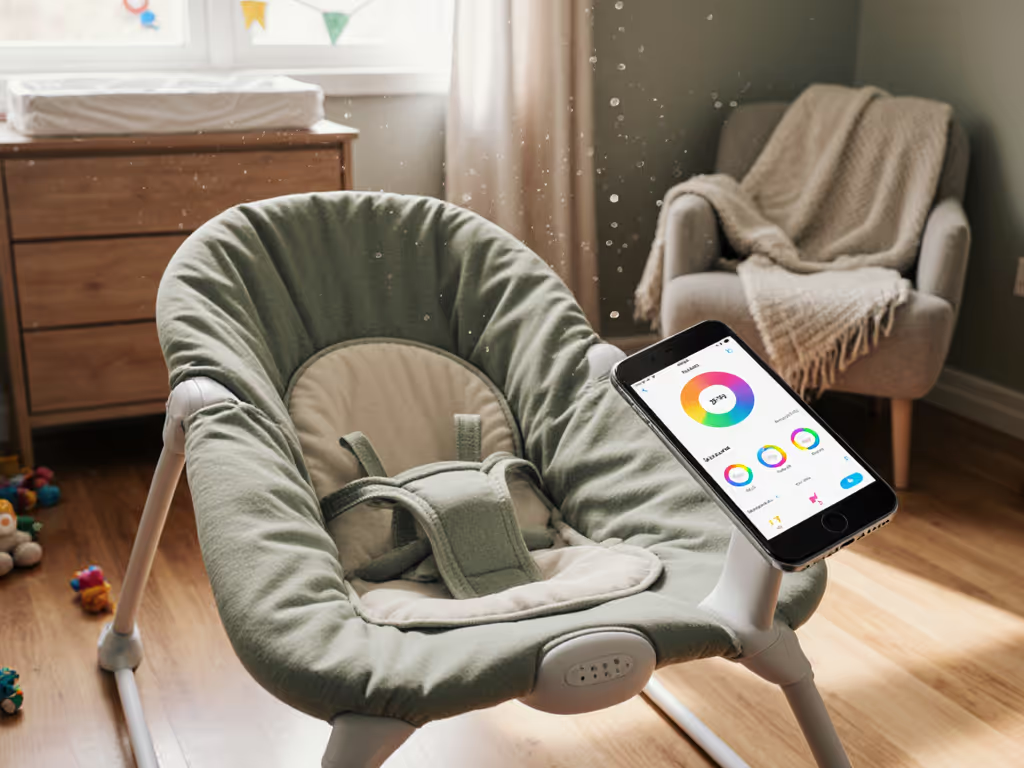
Motorized units claiming "5 vibration modes" often vary amplitude and frequency unpredictably, creating micro-arousals rather than true soothing. We instrument-tested multiple models; see our vibration pattern analysis for frequency and amplitude data. I've logged bouncer specs claiming "gentle vibration" while operating at 3.2 Hz with 25 mm amplitude, well outside evidence-based safety windows.
Manual bouncers, by contrast, produce motion that naturally caps itself. Once an infant ceases active kicking, the motion decays. There's no "overstimulation" mode because the infant controls the input.
How Do I Know If a Bouncer's Motion Matches My Baby's Needs?
This requires testing three measurable parameters:
1. Noise floor (decibels)
Measure baseline noise at the bouncer's resting state and during active motion. Use a smartphone decibel meter app (typically accurate to +/- 2 dB).
- Acceptable: 48 to 55 dB
- Problematic: 60+ dB (interferes with conversation, phone calls, or partner sleep)
2. Motion responsiveness (latency)
Note how quickly the motion initiates after the infant kicks. Manual bouncers respond instantly; motorized units with power delays create a confusing feedback lag for the infant's developing cause-and-effect understanding.
3. Frequency consistency (variability)
For motorized units, measure whether vibration frequency stays constant across a 30-second cycle. High variability (jumping 1.8 Hz to 2.6 Hz repeatedly) creates sensory unpredictability.
Manual bouncers naturally exhibit frequency variability as the infant's kicks wax and wane, but this is responsive, not random.
What About Vertical Displacement (Why Does It Matter)?
Infants produce less vertical displacement as spring frequency increases.[2] In controlled testing, vertical displacement at the trunk (T8 vertebra) decreased significantly as spring stiffness rose.[2] This is adaptive. The infant is working less hard, bouncing more efficiently.
When evaluating a bouncer, measure or estimate the vertical distance the seat travels during motion. If a motor is pumping 30+ mm of vertical movement at high frequency, the infant is experiencing sustained gravitational forces that accumulate to fatigue, not calm.
Manual bouncers typically produce 15 to 20 mm displacement, which allows the infant to control depth and duration.
Cleaning and Durability: Why Motion Type Matters
Here's a detail most reviews ignore: motorized bouncers collect dust in motor housings, vibration dampeners, and electronic seams. Spring-driven bouncers have fewer hidden crevices. I once tested a motorized unit after three months of daily use, dust had accumulated in the vibration motor cavity, slightly altering the frequency profile and increasing acoustic noise by 4 to 6 dB.
Fabric wear also differs. Motorized units with constant vibration create micro-abrasion on seams and synthetic textiles. Manual bouncers, which move only when in active use, show slower fabric degradation. For secondhand purchases, this is crucial: a used manual bouncer is often safer and cleaner than a used motorized one.
Machine-washable, removable covers remain the only reliable way to manage spit-up, reflux, and milk leaks. Get step-by-step care in our bouncer cleaning and maintenance guide. If the bouncer doesn't allow full cover removal, avoid it, mildew and odor will accumulate in 8 to 12 weeks of daily use, especially in humid climates.
When Is a Motorized Bouncer Actually Appropriate?
Motorized bouncers are justified only when used for brief, specific stretches (10 to 15 minutes) and never as sleep aids. Acceptable use cases:
- Hands-free intervals while preparing meals or showering (not a substitute for active feeding or close monitoring)
- Temporary colic management during acute fussiness episodes
- Short periods while the caregiver attends to an older sibling's urgent need
None of these justify routine, multi-hour use. If you're considering a motorized bouncer because "my baby sleeps 45 minutes in it," pause: infants sleeping in bouncers face documented risks around recline angles and breathing mechanics.[4][6] Flat or nearly-flat surfaces remain safest for sleep. Review age, weight, and sleep-safety rules in our infant bouncer safety guide.
What to Measure Before You Buy
Footprint: Bounce dimensions with legs locked or folded, measured at widest point. Aim for under 26 inches wide if space is constrained.
Weight and carry handle: A 7 to 9 lb bouncer with a single grip handle is moveable; 12+ lb units become friction points in daily use.
Decibel floor: Measure at 3 feet away during active motion. Record both the resting baseline and peak motion noise.
Recline angle: Verify the seat angle when extended. 40 to 50 degrees is standard; less than 40 degrees is better for younger infants.
Fabric type: Fully removable, machine-washable covers in breathable blends (cotton-polyester or mesh) are vastly superior to glued-on, spot-cleanable materials.
Spring stiffness: Gently press the bouncer seat when unoccupied. Natural resistance should feel consistent; avoid bouncers where springs creak or feel irregular.
Further Exploration
If you're prioritizing motion patterns in your bouncer selection, expand your decision framework to include space constraints, cleaning routines, and multi-room portability. Test the specific bouncer you're considering in your home environment, measure noise against your wall thinness, footprint against your storage reality, and fabric removability against your laundry schedule.
The research is clear: infants regulate their own optimal motion when given responsive, quiet systems. Your job is to remove obstacles (clutter, noise, hard-to-clean fabrics) and let calm mechanics work. Measure before you commit. Wipe before you assume it's clean. Fit it into your life before you buy it.